PROJECT DESCRIPTION
PROJECT SCOPE
The project focuses on creating an educational and research framework that combines theory and practice around sustainable materiality. It establishes a collaborative environment where professionals from different fields—architects, designers, artists, and researchers—explore new ecological mortars and biomaterials. Its scope is not limited to theoretical investigation but extends to experimental testing and practical small-scale applications, such as furniture, objects, and installations. At the same time, the project seeks to redefine the role of materials as carriers of ecological, social, and cultural meanings, placing sustainability at the center of design. Through this process, it proposes an alternative production model that connects environmental responsibility with collective creativity and knowledge-sharing.
PROJECT OBJECTIVES
The project's objectives operate on multiple levels, combining knowledge exchange, innovation empowerment, and the promotion of the social dimension of creative production. A key objective is to familiarize emerging creators with sustainable design and construction practices, with an emphasis on low environmental-impact materials. At the same time, the project aims to develop innovative materials and promote the circular economy by replacing linear production models with practices of reuse and biodegradation. Particular emphasis is placed on connecting traditional techniques with contemporary digital methods, creating hybrid production models. Furthermore, the project seeks to democratize knowledge through open-access tools and to strengthen participation and engagement.


PROJECT ACTIVITIES
The project unfolds through three consecutive and interconnected phases that cover the entire spectrum from research to dissemination. The first phase constitutes the core of the project and is implemented through a Residency, where theoretical and practical exploration of materials and techniques takes place, alongside experimentation, design, and prototype development. In the second phase, knowledge is transferred to the broader public through open workshops involving other creators and wider social groups, resulting in pilot applications. Finally, the third phase focuses on documenting and disseminating the outcomes through a digital repository, publications, and public presentations, fostering public dialogue around sustainable construction.
RESIDENCY PROGRAM
The Residency serves as the project's central implementation mechanism and operates as an intensive six-month cycle of collective research and creation. Ten selected professionals from diverse disciplines participate, collaborating within an experimental framework using raw materials such as organic matter, geomaterials, and industrial by-products. The programme includes structured workshops with theoretical lectures and hands-on training, as well as extensive access to laboratory equipment for both individual and group research. Participants develop experimental mixtures and gradually create prototypes and small-scale constructions, incorporating principles of circular economy and sustainability. The Residency concludes with a public presentation of the outcomes and serves as a bridge to the project's subsequent activities.


INTERDICIPLINARY APPROACH
Interdisciplinarity constitutes a fundamental pillar of the project, both in its design and implementation. The project brings into meaningful dialogue fields such as architecture, design, and art with the natural sciences, particularly chemistry, engineering, and materials science. The collaboration between the LUDD team and the Laboratory of Chemistry and Materials Technology (ECHTY) of the National and Kapodistrian University of Athens (NKUA) ensures the connection between experimental creative practice and scientific research and documentation. At the same time, the diverse professional and research backgrounds of the participants create a fertile environment for knowledge exchange. This convergence is expected to generate new hybrid methodologies of learning and production, where theory, science, and practice coexist dynamically.
PROJECT INNOVATION
The project's innovation is structured as a multi-layered system that combines technical, methodological, and social dimensions. On a technical level, it introduces the development and application of biomaterials and alternative low-impact mortars, promoting the replacement of energy-intensive materials and linking traditional techniques with contemporary digital fabrication methods. On a methodological level, it innovates through the adoption of participatory learning models, such as the Residency and open workshops, which are grounded in experiential and collaborative knowledge. Furthermore, it proposes a hybrid model of collaboration between the social economy and academic research, based on a horizontal and cross-sectoral structure. Finally, on a social level, it promotes open access to knowledge and the creation of communities of practice and inquiry, contributing to the development of a new, more democratic, and sustainable ecosystem of design and production.

CATEGORIES OF BIOMATERIALS
ECOLOGICAL MORTARS
Ecological mortars are construction materials based on lime or clay, combined with aggregates (such as sand, perlite, and ash) and water, with the addition of organic or biological components to improve plasticity, strength, and microstructural stability. Their production utilizes local resources and reduces energy consumption, while the participatory approach enables collective experimentation and learning. Such techniques embody principles of the circular economy and promote local expertise in sustainable construction.

BIOPLASTICS
Bioplastics are natural polymer-based materials that are biodegradable and characterized by a low environmental footprint. They are derived from starch, proteins (such as gelatin), or algae polysaccharides (agar). Their structure can be modified through plasticizers and temperature control, affecting elasticity, brittleness, and transparency. They are produced through simple thermochemical processes, enabling coloration and the fabrication of small-scale films. Bioplastics function as an educational tool for linking chemistry, materiality, and design, while enhancing understanding of the relationship between polymer composition and material properties.

PAPERCRETE
Papercrete is a cellulose-based material produced from pulped recycled paper combined with inorganic or organic binders, such as lime, clay, or small quantities of cement, together with water. They are distinguished by their low weight, good thermal insulation performance, and ease of shaping. As biodegradable and low-energy alternatives, they are suitable for non-load-bearing building elements, sculptural panels, and sound-absorbing components. The technology supports circular economy principles and educational workshops focused on sustainable construction.
MYCELIUM MATERIALS
Mycelium materials are biologically produced composites in which fungal mycelium acts as a natural bio-binder, binding lignocellulosic substrates (such as sawdust, straw, and bark) into cohesive, porous, and lightweight structural elements. Their production requires low energy input, controlled temperature, and humidity conditions, resulting in fully biodegradable, thermally insulating, and sound-absorbing blocks. Within workshop and laboratory settings, mycelium materials are used for non-load-bearing construction elements, temporary structures, and experimental architectural prototypes.


ΣΥΜΜΕΤΕΧΟΝΤΕΣ RESIDENCY
ΑΓΓΕΛΟΣ ΣΩΤΗΡΙΟΥ
ΒΑΓΓΕΛΗΣ ΣΑΒΒΑΣ
ΒΑΣΙΛΙΚΗ ΗΛΙΟΠΟΥΛΟΥ
ΕΙΡΗΝΗ ΒΑΛΛΗΝΔΡΑ
ΙΦΙΓΕΝΕΙΑ ΠΑΠΠΑ
ΚΩΝΣΤΑΝΤΙΝΟΣ ΖΒΕΣ
ΚΩΝΣΤΑΝΤΙΝΟΣ ΚΩΤΣΗΣ
ΜΙΝΑ ΑΡΧΟΝΤΑΚΗ
ΤΖΩΡΤΖΙΝΑ ΧΟΛΕΒΑ
ΧΡΙΣΤΙΝΑ ΖΑΜΠΟΥΛΑΚΗ
______________________________________________________________________________________________________________________________________
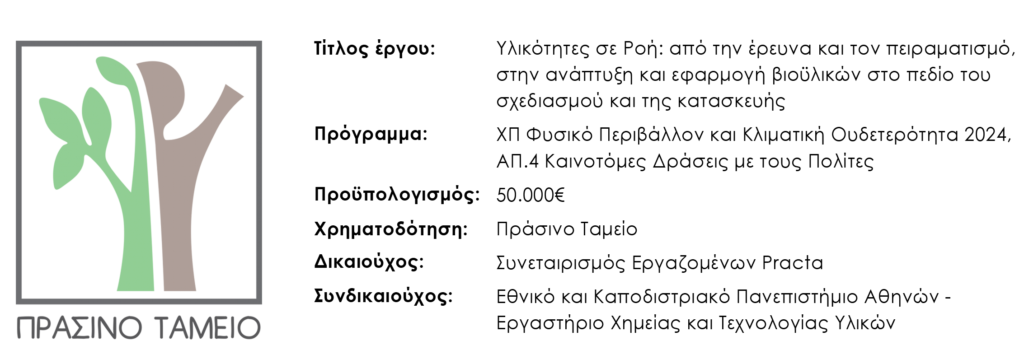
The project is funded by the Green Fund under the program Innovative Actions with Citizens 2024 and is implemented in collaboration with the Laboratory of Chemistry and Materials Technology of the National and Kapodistrian University of Athens.